Showing posts with label Science. Show all posts

Top 3 Wish-listed Items- Linky Party

Sunday, November 27, 2016


Are you looking for engaging reading passages to use for Close Reading?  I looked far and wide and decided to create these passages to use with my higher level readers.  Kids love animals so I made a list and asked my husband (who is really a big kid at heart) which animals he would like to read about.    I used his top picks and made challenging yet not too difficult reading passages for my kiddos.  I used them in my reading groups before putting them on TpT.  (After all, if I don't think it's a great product- it's not making it in my store!)


Next we have a great report writing resource that combines learning about farm animals with writing about them.  


I made these to use during our Farm Animal Unit.  
As you know, kids come in all sizes, shapes and levels.  I made this differentiated to scaffold the writing for my struggling students and very open ended for my confident writers.  There are directions for directed drawings of the animals, close reading passages to get information, differentiated rough draft and final copy pages, and so much more.  

These are a great introduction to report writing and research.  


And finally, here is my top wish listed science activity.


These activities are hands-on and really make the kids think.  They are given basic information about pushes, pulls and force and then they are challenged to complete different activities.  

These are perfect for cooperative groups!  Kids really need to work together to problem solve and come up with the solutions.


Thanks for stopping by and taking a look at some of my most sought after products.  


Cheryl Irick

Butterfly Release

Saturday, June 4, 2016


Each year I get caterpillars for my classroom.  The students watch as they grow from tiny little caterpillars, morph into a chrysalis, and then finally emerge as butterflies.

The whole metamorphosis process is absolutely amazing to the kids (me as well) and they eagerly rush over to the enclosure each morning to take a look at the progress.

When all of the butterflies have emerged and we have completed our observations, it's time to set them free.

I've been doing this for a number of year (too many to count) and it's always a bit disappointing for the kids who desperately want to hold one, only to have them flutter away before getting a chance.  
That's usually what happens.

(The kids are eagerly hoping that the butterfly won't fly away before at least one child gets a chance to hold it on their finger)


Well, this year it was different!

One of our butterflies had a folded wing and couldn't fly.  I used this to our advantage.


This little butterfly made our day!  


I sat all my kiddos in a circle on the grass and we gently passed this little guy around one at a time.


All of my kiddos got a turn holding our new butterfly friend.  


They were so gentle (even though they were incredibly excited) and they noticed things about the butterfly that they hadn't mentioned when we were looking at them in the enclosure.


After everyone got a chance to meet our special butterfly, we took him over to our garden and set him loose on a flower.


He immediately settled in and my kids looked for him every time we walked past.


The whole process of METAMORPHOSIS is really amazing to watch.

Now whenever my kids see a butterfly fluttering around our campus they immediately think it's one of our butterflies and they squeal with joy.

I love the joy of kindergarten!


Animal Habitats- Combining Art and Science

Friday, June 3, 2016

We've been learning about animals and their habitats these last few weeks.  

I've been incorporating a lot of art during our lessons and my kids have been loving it!

After learning about water habitats, I did a directed draw with my kids and then we painted with watercolors.  Here are a few of our fish paintings.  Aren't they cute?

Watercolor fish- Easy kindergarten art project

Fish habitats- incorporate art into your science curriculum

The bubbles crack me up.  I didn't tell them to do that, one child added them and I commented about how cute it was and then, wouldn't you know it, all of the other kids started drawing bubbles too.
(That's the magic of kindergarten)

Colorful watercolor fish- easy kindergarten art project


Here are animals in a different habitat- The Savannah

To make these we drew lions together with black crayons.  When the lion was done, I told the kids to use a brown crayon to color in the mane and tail.   I then mixed up a nice yellow/brown and the kids painted their lions.

Mixed Media Lion- crayon and paint

Lion- drawn with crayon and painted with tempra paint

Some did the lion and the background in the same brown color (for camouflage) and others used the green paint (because it was spring).  Love how these kids justify their color choices!

Lion- draw with crayons and paint- Fun mixed media project

Mixed Media Lion- crayons and paint

These are super fun and really easy. 
The combination of crayon and paint gives a nice mixed media effect.

Combine Art and Science- Draw animals in their habitats
Fun Kindergarten Art Project


It always amazes me how I can guide them through the drawing one step at a time and all of their pictures come out so dramatically different.   The personality of the artist really shines through.

I just had to share these because I think they are so cute.  They make me smile each time I look at them.


Outer Space Adventures in Kindergarten

Saturday, April 30, 2016


We've been learning about the Solar System in my classroom.  We began by studying the planets and singing this song...
I originally found the song on the Smithsonian website, but I changed the words for a few verses to accommodate my needs.  You can click on the song to go to the original site and find the original words.

Then we made these adorable astronaut helmets so we could take our own journey into space.


We did this by taking a brown paper grocery bag and rolling the bottoms.  We then cut out the hole for the face and painted the bags white.  The kids had a blast making them.  We put them on each time we travel to our Space Lab.


Here is our Space Lab.  This is a Project Based Learning Environment.  These are the current activities, but they will be changing as we delve deeper into our Space Exploration.

We explore how craters are made on the moon.

To make the "cloud dough" I added baby oil to flour and mixed it until it was soft, silky and the flour didn't puff when a rock was dropped into it.  The kids wear the "safety goggles" for added effect.  Be careful though as the flour/oil mixture becomes extremely slippery on tile. 


 We use "space sand" to write letters, numbers and words.

The kids are sure that the red sand has come from Mars and Jupiter.  They think the white is from either the moon or Mercury and of course, the blue sand is from Neptune (even though it's a big ball of gas).  Love it!


 We have an International Space Station where the astronauts live while they are in space.

The kids are having fun pretending to be astronauts living in the Space Station.


 We have a Space Travel Agency that gives potential space travelers tickets to different planets.

This is a popular center with everyone wanting a turn as the Travel Agent.  I have an old keyboard that they use to type out the tickets.


 We have a Robotics Center where we learn coding and program the robots to do different things.

We have Bee Bots that are perfect for kindergartners.  We set up mazes with tape or blocks and the kids program the robots to go through the maze.  This is great for problem solving and writing simple code.


 We have a Spatial Reasoning Center where we complete puzzles and do different tasks.

The kids enjoy the challenges of these puzzles.  I inherited them from a teacher who retired 10 years ago.


We conduct experiments on "Moon Rocks".

I made "Moon Rocks" by adding glitter and black paint to baking soda.  I used just enough water to form rocky balls.  The kids put their "Moon Rocks" into cups and added vinegar one drop at a time.  The results were fizzy fun!  We recorded the results of our experiment on the sheet.


 We use toothpicks and play dough to make different shapes.

This center develops fine motor muscles and helps the kids work on shape identification.  


The kids are working on making a Mission Control so we can launch rockets into space.

This week we will be making rockets and learning about the forces needed to launch them.
We are also creating a BioSphere area where we learn about the plants and animals that inhabit the Earth (perfect for Earth Day!)

I am following the lead of my students and the activities and areas in our Space Lab are constantly changing and adapting to our needs.  I will make another post about our Space Lab before the school year ends so you can see some of the other activities that we are doing.

There are a lot of great resources on Teachers Pay Teachers and Pinterest for space activities.  Many of the things that I did in my classroom were inspired by things that I found on both.


Ocean Invertebrates Unit

Friday, June 26, 2015
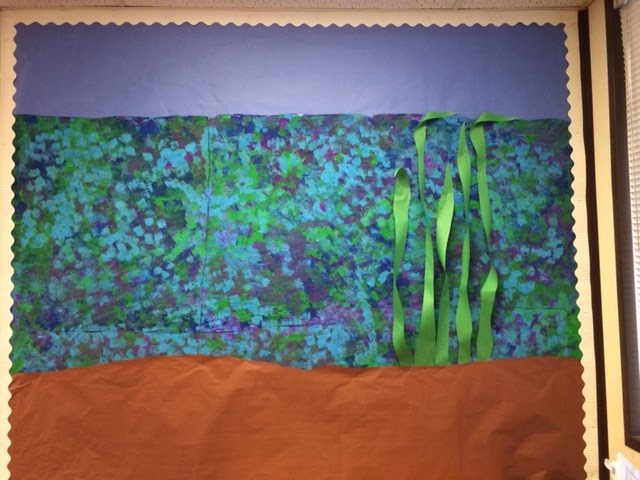
I usually end the school year with an ocean unit.  We begin by learning that 70% of the earth is covered by water, so learning about the plants and animals that live in the ocean seems like a good idea.  I have the kids paint the ocean water first.  This is very messy and very fun.  I give them green, turquoise, blue and purple paints and sponge brushes.  The kids have to dab the paint onto the paper.  They race to fill in the empty spots.  I love that every year my ocean looks different (just like the kids who painted it).

ocean bulletin board

After we get the water finished, I put it on a bulletin board.  I add some sand on the bottom (brown paper) and this year for the first time,  I added some blue sky above the water  (I like to mix things up every now and then to keep it interesting).  Then we talked about the food chain and we learned that their are plants at the bottom of every food chain, so the kids asked me to add plants to our ocean.

Now that our ecosystem is ready, we need to figure out what animals to add.

We watched a Magic School Bus movie about the coral reef.  The movie showed many different animals that lived around the reef.  So of course, we had to make coral to add to our ocean.  To do this, I let the kids choose red or orange construction paper.  I used 12x18inch sheets and the kids traced their hands and arms all the way from fingertips to elbow.  They could fit two hands on a sheet.  They cut them out and we began building our coral reef.


Isn't it pretty?  Now we are ready for some other animals.  Since we are studying animals that sting (like coral polyps) we made anemones and jellies.  The anemones have stingers that point upwards and the jellies stingers hang down.  Here are close up pictures of those animals added to the ocean.

sea anemone craft and activity

jelly fish activity


We also made crabs, sea urchins and sea stars.  


sea star craft

Here is our finished ocean bulletin board.  Isn't it beautiful?
The kids loved learning about each ocean animal and the hands-on craft really helped them remember the important things about each animal.  Each day that we completed an animal, I would add them to the bulletin board the next morning before school.  It was so fun to watch the kids drag their parents over to the board first thing and look to see where their  animal might be.  They would tell their parents all about the animal.  

Ocean Invertebrates bulletin board


If you are interested in doing this in your classroom, you can purchase my unit on my TpT store.  It contains close reads about the animals as well as comprehension sheets.  The directions for making each component are also included.  You will be amazed at how much your kids learn about the ocean invertebrates.

We also study fish and marine mammals.   You can see the sea horses and Girabaldi swimming along with the invertebrates and plants.


Powered by Blogger.
Back to Top